


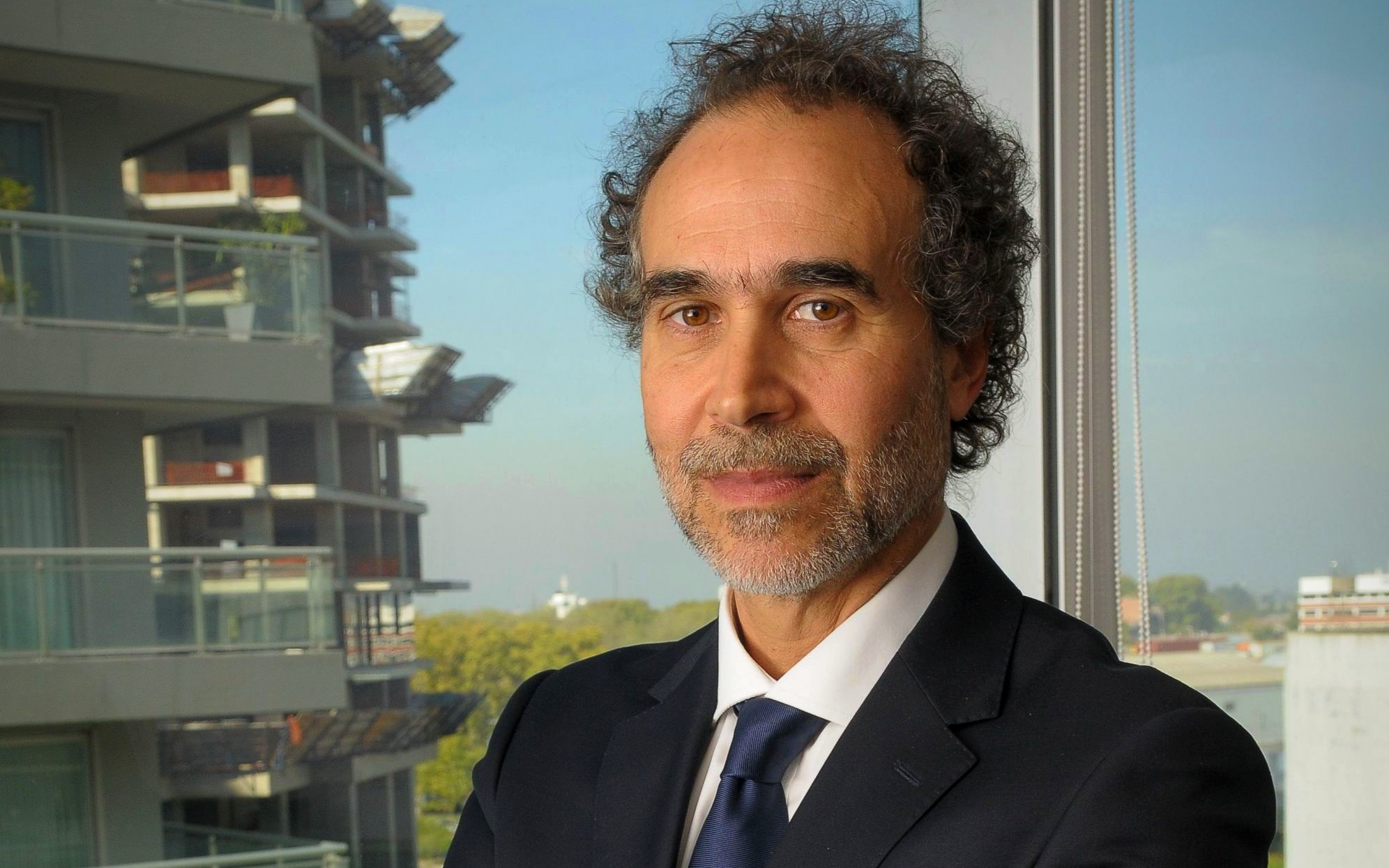
Daniel Vázquez is Executive President of Ingener, a Uruguayan construction company specializing in energy infrastructure that arrived in Argentina in 2016 and rode the wave of renewable energy projects. He describes the differences between his country and the Argentine market, and explains why he is looking towards the oil industry, mining and the export of services.
Daniel Vázquez is constantly crossing the River Plate. A Uruguayan, he is CEO of Ingener, a construction company that, after 25 years, has become a benchmark in energy infrastructure on both sides of the Río de la Plata. Its portfolio includes wind, solar and thermal generation projects totaling more than 1,400 megawatts (MW), some thirty high- and extra-high-voltage substations, and flagship projects such as the Botnia mill in Fray Bentos.
“In Argentina, business moves and gets done at twice the speed. It is a much more dynamic market, used to the fact that once things are decided, they get done,” he says of the country where the company—which has annual revenues of US$70 million—landed in 2016 and where, after gaining a (strong) foothold in renewables, it is now also betting on oil & gas, aiming to double in 2023 the revenue it generated in the local market in 2022.
“The pace of execution is different, not only compared with Uruguay, but also with Paraguay or Bolivia. That is why, once the economic situation settles, this will be a different economy,” he reflects in his Buenos Aires office at Madero Harbour.
What do you attribute that to?
There is a much stronger industrial culture here. Other countries, which have other virtues such as greater stability, are slower. But in Argentina, if I look at it end to end, from the moment someone comes up with an idea until it materializes, that cycle happens at twice the speed.
One might assume that, since it is a more orderly country, things should be less complicated in Uruguay.
In Uruguay, the financial side can be more flexible. In Argentina, it is much more day-to-day. Financing rates force very short-term management. Otherwise, no budget could afford borrowing at those rates to cover the three months of negative cash flow a project has. In Uruguay, that does not move the needle; one or two months of mismatch are easier to handle. In Argentina, you have to be much more orderly and careful with a project’s cash flow. Here, execution can indeed be delayed by those contingencies.
How do you manage that financial hedging?
We try to keep contracts matched. Costs in local currency have adjustment formulas. Anything related to imports is tied to the dollar.
The company arrived in Argentina in 2016 and established itself in renewables, which later came to a halt. Where did you refocus?
Until 2018, we had a significant share in wind farms. Then there was a lull, a major standstill, due to economic conditions such as interest rates and currency problems. The rules changed for these projects, which rely fundamentally on long-term financing. That recovered later, when local investors returned and companies long established in Argentina took over the projects. At that point we started, at the very least, to bid on and carry out some of them. That allowed us never to stop working, even in the most difficult times.
Exclusively in renewables?
What emerged strongly as something new for us was the oil & gas sector. Recently, we have closed contracts with Pan American Energy (PAE), both for upstream projects in the South and downstream works at the Campana refinery. These are the kind of relationships we like to have: we take great care with deadlines and project management, so that they are not one-off contracts but lasting relationships. That is the difference of working with the private sector.
Why?
Because that is where the kind of service we provide is most valued. In the public sector, it is harder to add value from a management standpoint. The project’s conditions are fixed, based on what was already defined in the tender.
Which industries are demanding the most services right now?
At present, due to the economic situation in Argentina, export-linked sectors need to expand and grow. We see opportunities there. Another avenue is the export of services. Many of our projects in Peru or Paraguay are carried out with human capital from here. The business is becoming less and less about construction and more complex: it is about management, solving the client’s problems.
For example, sourcing supplies. How do you manage that with the current restrictions?
We source locally everything we can. If there is a domestic option, we work on it with the client and evaluate it. Of course, some items can only come from abroad. In our case, since our clients are exporters, they end up importing them themselves.
And clients who do not have that capacity?
The main purchases are worked on well in advance, so that the longer lead times caused by possible import delays do not affect the works. The problems are not only due to local import restrictions. Foreign manufacturers are also facing major difficulties: they were overbooked after the pandemic and global supply chains have deteriorated. Management is much more complex than before, when everything was solved with a purchase order. Not anymore. You have to work closely with the client and the manufacturer so that the equipment arrives on time and as specified. But if it were simple, they would not hire us.
Is payment abroad also a barrier?
Structuring the payment is simpler; there are solutions. But there is also an extra cost because it takes longer. Our contribution is our engineering knowledge, which allows us to launch, in the very first weeks, precisely those long-lead but critical items—the main equipment—and, on that basis, define the administrative import steps. Finance can be a constraint, that is true. But there are solutions. In the end, it is a matter of credit. Of timing.
Are you looking to expand your presence in oil & gas?
There will be a very important period in Argentina in which oil & gas will be a driving force. We will be there. Its resources will allow the country to be a key player in the energy transition. There will be quite a few years in which activity will be strongly and permanently focused there. Renewable projects aimed at green hydrogen are also starting to appear. When that takes off, Argentina, with its wind resources, has almost unlimited potential.
But first, you have to cross the desert.
Since these will ultimately be export businesses, the economic situation should be well on track by then and will not be a barrier for these projects. In addition, they will be tied to long-term contracts, which is what makes them viable. They will be ring-fenced.
What other sectors are you looking at in the shorter term?
We are starting to see this oil & gas opportunity, which is very important. It will have good stability in the coming years. In renewables, we see potential in a few years’ time. With a little more clarity, mining too, whether lithium or in general. For us, it could be another powerful export industry. So far, we have submitted more quotes than closed contracts there.


